1 The posts

LinkedIn · from Vasek's personal profile

After 2 billion sandboxes, we can usually tell what your agent will need before it even starts.

Which tools it will reach for, and how much CPU and memory it will need at peak.

That took a while to learn. When we started in 2023, an agent might succeed 3 times out of 10, and our first billion sandboxes took 3 years. The second billion took 5 months. Today agents are 61% of our traffic, and many of them work for hours on real company data.

For a team running agents, that knowledge is the difference between sizing every machine for the worst case and giving each agent the right environment before it asks.

Most evaluations still stop at boot time and price per vCPU-hour. I'd add one question to ask any agentic platform you're considering: how many agents like yours have you run, and what does the platform do differently because of it?

The alternative is building the platform yourself. Genspark's CTO told us they couldn't have hit $250M ARR if five of their engineers had been building a sandbox platform instead of the agent.

If your agents are already in production, send me what broke. There's a decent chance we've already seen it.
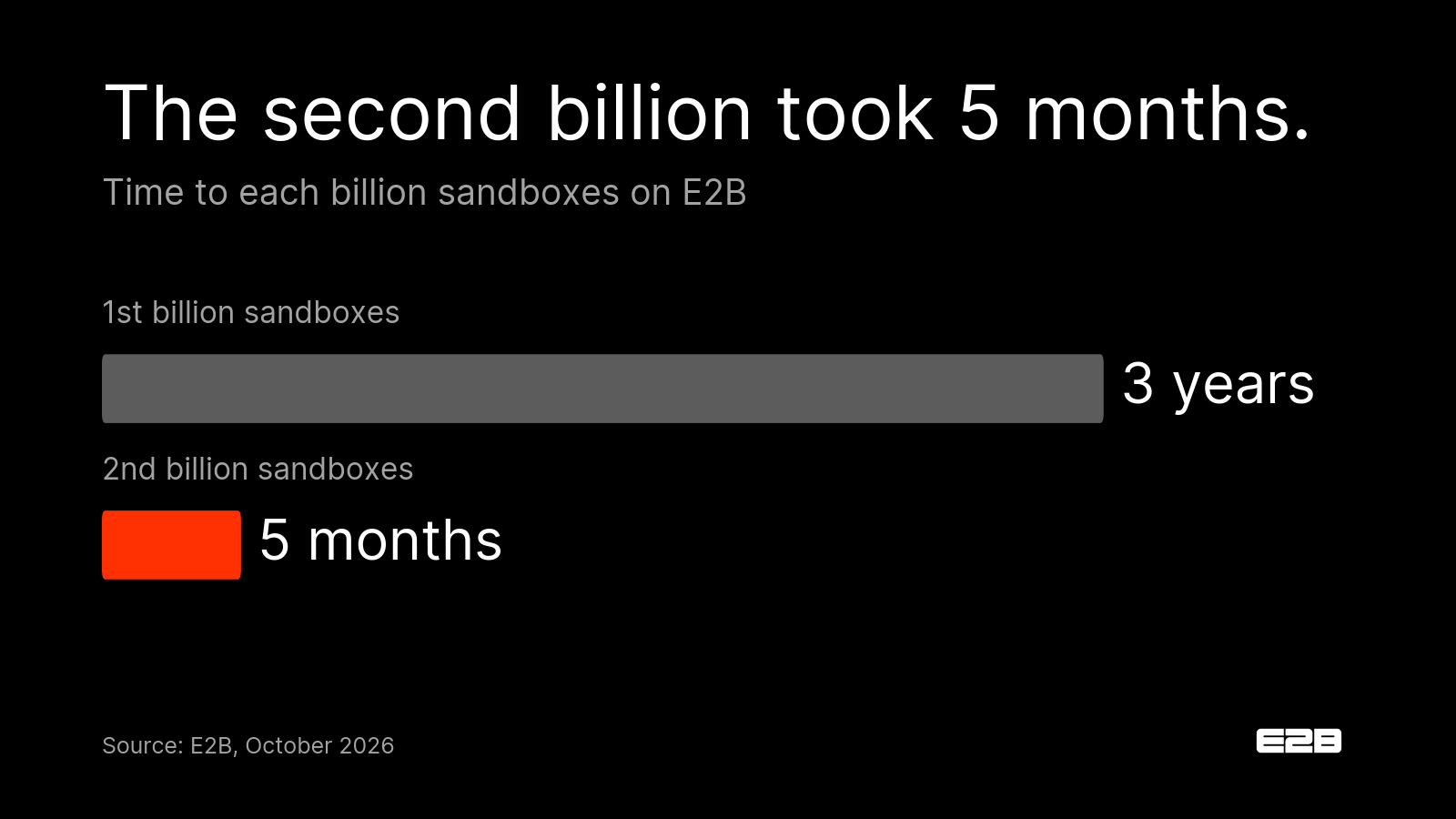
Bar chart titled 'The second billion took 5 months.' E2B's first billion sandboxes took 3 years; the second billion took 5 months.

First comment, from Vasek

I wrote up how we got here and where we're taking it next, an agent-driven cloud that sets itself up for each task: https://e2b.dev/resources/sandboxes-are-dead

X · from @mlejva

After 2B sandboxes on @e2b, we can usually tell what an agent will need before it starts: which tools, and how much CPU and memory at peak.

That knowledge is how you stop sizing every machine for the worst case.

The same chart: E2B's first billion sandboxes took 3 years; the second billion took 5 months.

Reply to the post, from Vasek

How we got here and where we're taking it next, an agent-driven cloud that sets itself up for each task: https://e2b.dev/resources/sandboxes-are-dead

2 Why this is the best way

Vasek's posts get almost twice the engagement of E2B's brand account, yet most of what he publishes is announcements and reactions to other people's takes. His best idea, laid out in his essay Sandboxes are dead, rarely gets a post of its own in his feed, so I saw an opportunity to give it more reach.

The goal: top of the funnel with enterprise buyers

I chose a thought-leadership angle aimed at enterprise buyers on purpose. The job of these posts is to reach CTOs, Heads of AI, and platform leads at AI labs, fast-scaling agent companies, and large enterprises, and get them thinking about how they'll run agents in production. Purpose-built sandboxes, and E2B, should be part of that thinking long before anyone writes an RFP.

That's top-of-funnel work, so the posts are written to travel organically and to be boosted to the exact accounts we want. More on that below.

Adapting the style to the persona

I kept what makes the voice Vasek's: real numbers up front, plain words, "we" more than "I," almost no emoji or hashtags. Then I adapted the style to the persona these posts need to reach.

His most viral posts are lowercase one-liners like "startups should not be building coffee shops" (126k views). They work for founders and engineers on X, and they're the wrong register for a CTO deciding where thousands of agents will run. The posts I proposed aim to show up with Vasek's unique perspective in front of potential buyers, not just meme consumers.

Why this angle

Any agent-infrastructure company can say "agents need real computers." Only E2B can say it has run 2 billion sandboxes and learned what an agent will need before it starts. Leading with that claim moves the conversation away from boot time and price per vCPU-hour. It gives buyers a new question that E2B wins ("how many agents like yours have you run?") and backs The AI Agent Cloud category with proof. Genspark's CTO handles build vs. buy in his own words.

Vasek's account already gets about 1.7 to 1.8x the brand's median engagement, so the posts start there. LinkedIn Thought Leader Ads then let us put budget behind his post and target it by title, company size, or account list. That's why the copy has no link, no launch language, and no milestone that goes stale. LinkedIn carries the full argument for buyers, and X carries the same idea in a few lines for engineers at the labs. Organic tests the message, and paid scales the winner into the accounts that matter.

How I made it

I built and ran the process as an agentic workflow after setting the direction on style, goals, evals and angle:

How I'd measure it

Engagement from target titles and accounts, cost per engaged buyer on the boosted version, and pipeline influenced by those accounts within 60 to 90 days.